


How Rudolph the Red-Nosed Reindeer Became Every Marketer’s Dream

Robert May’s Iconic Creation

Hermey the Elf and Rudolph the Red-Nosed Reindeer, 1964. Photo: Wikimedia Commons
I was six years old when the movie version of Rudolph the Red-Nosed Reindeer premiered on NBC in 1964. Maybe it’s because I was at the perfect age, but I fell in love with Rudolph and sympathized with Hermey, the poor elf who really wanted to be a dentist. (Looking back, I think now I identified with Hermey because of the uncontrollable big blonde swoop of his bangs, similar to my own.)
But almost fifty years later, as an adult copywriter, writer, and marketer, I have a new appreciation for the story of Rudolph the Red-Nosed Reindeer because it’s an awesome tale of persistence, creative work, and principles of marketing.
How a copywriter and employee gave birth to a reindeer
Robert May was a 1926 graduate of Dartmouth College who did several stints around the country, including working as an ad writer for Gimbels and Macy’s in New York City. In 1936, he was offered a job with Montgomery Ward in Chicago, and he picked up his family and moved.
In early 1939, Montgomery Ward was in fierce competition with Sears to be the biggest retailer and mail-order store in the country. To get more customers, Montgomery Ward had a heck of an idea, a sales gimmick to get more families with children into their store, particularly their toy department at Christmastime.
In the past, Montgomery Ward had given away coloring books, but this year, they decided to create their own unique Christmas story and hand them out at all six hundred locations across the country.
As with all major marketing projects, there has to be a lot of lead time to allow for revisions, approvals, edits, artwork, printing, and delivery of the final work. Sometime in early 1939, Montgomery Ward offered Robert May a project. He would write the giveaway Christmas book as an extra project. Their only requirement was that the story was based on an animal. May accepted. He worked weekends and evenings on his story, combining his own childhood experience as an underdog, (he was small, shy, and nerdy,) with his daughter’s love of reindeer at the Lincoln Park Zoo.
Marketing principle #1: Persistence
To be a successful copywriter and marketer, you have to have persistence.
Robert May had it.
When Robert May accepted the assignment for the giveaway Christmas story, his wife was battling cancer. She died a few months later, leaving May to raise his four-year-old daughter, Barbara, alone, struggling under a mountain of medical bills.
Afraid that the story wouldn’t be finished because of grief and the added responsibilities of taking care of a toddler, May’s employer encouraged him to turn the project over for completion by someone else. May, however, declined. Later in his life, he looked back and said that he couldn’t give up on his reindeer book. He refused to stop working on it because, he stated, “I needed Rudolph … more than ever.”
Luckily for the world, Robert May kept going.
Marketing Principle #2: Creative Work
Lots of factors went into the creation of Rudolph. One of the things May did was to create a list of possible names for his main character. Today, we can’t imagine the story with any character name other than “Rudolph,” but May had a working list of possible names which included Roderick, Rollo, Romeo, and Reginald.
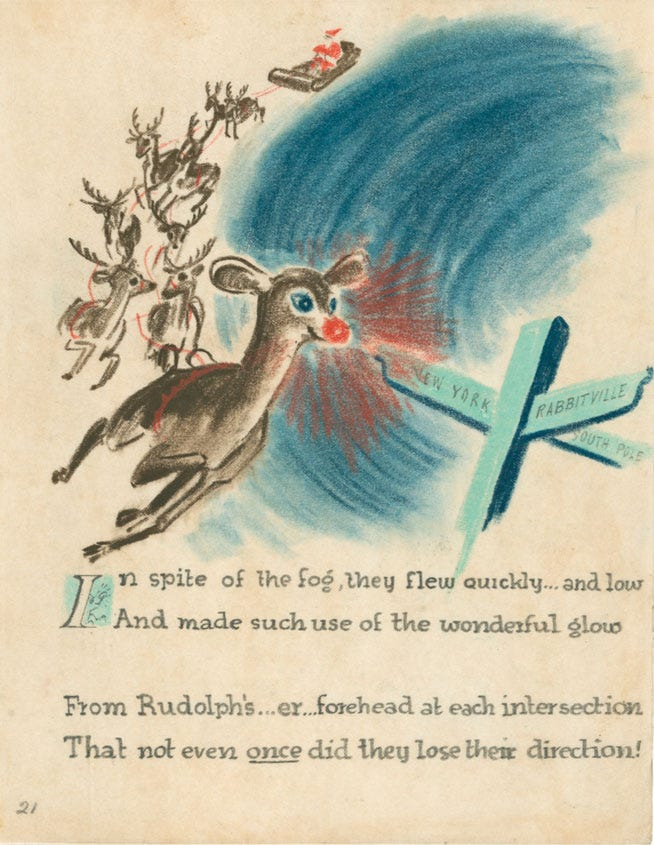
Like all good copywriters, Robert did his due diligence. His daughter, Barbara, remembers going to the zoo with her dad and the illustrator, Denver Gillen, as they would study and sketch the reindeer, getting ideas for Rudolph.
If you’ve worked in the creative world at all, you know that not everyone shares your vision.
At first, May’s employer wasn’t thrilled with the concept of a reindeer with a bulbous red nose. Years later, May reported that his boss’ original response to Rudolph was, “couldn’t you come up with anything better?” With the help of the sketches, May was able to convince the company to go ahead with Rudolph.
No project in the advertising world can move forward without stringent review processes. Rudolph is no exception. Ironically, the book was almost scrapped because a focus group worried that the red nose would have the connotations of an alcoholic.
But Rudolph’s unique physical trait, and May’s belief in his special reindeer, won out.
Marketing principle #3: Belief in your project
Robert May created a story about a misfit reindeer who becomes a hero and helps Santa make the world a happier place. In 100 rhymed phrases — complemented with illustrations of red, brown, and blue — Robert May touched the hearts and minds of kids. (Presumably increasing the profits for Montgomery Ward that holiday season in the process!)
From the beginning, May felt the potential of his project. Not only did he keep working on it after his wife died, but he also got in touch with his former colleagues at Dartmouth asking them to connect him with the people at Walt Disney about the possibility of making an animated feature starring Rudolph.
Interestingly, the artist for Rudolph, the young Canadian, Denver Gillan, went on to become the chief illustrator for the enormously popular Readers Digest.
Marketing Principle #4: Success belongs to the copyright holder
Rudolph the Red-Nosed Reindeer was a phenomenal success. Montgomery Ward distributed 2.4 million copies of it in 1939. It was even more popular the next year.
Montgomery Ward continued to print and distribute these books every year at Christmas until World War II curtailed the practice because of paper shortages.
May was dedicated to his project, and apparently, he was very loyal to his company. In 1943, during World War II when Montgomery Ward wasn’t distributing the books, the company offered to return the copyright to May, but he didn’t accept the offer because he wanted to resurrect it for one more Christmas season, a move that May later acknowledged was “foolhardy and/or courageous.”
May’s faith in Rudolph paid off — eventually. Montgomery Ward distributed 3.6 million copies of the book when it became a giveaway book again in 1946, increasing its popularity.
Robert May was making no money on his creation — until he was approached by a music company.
Marketing Principle #5: Don’t limit the use of your product
Finally, Robert May would have a chance to earn royalties on his Rudolph story.
Because the giveaway book had become wildly popular, Robert May got his chance to start making money on it.
RCA/Victor contacted Robert May about the copyright and the potential to make a song about Rudolph. Two things worked in May’s favor. First, a rep of RCA/Victor named Norton encouraged Montgomery Ward to turn the copyright over to May. A retail store, after all, was not set up to handle royalties and music deals. Finally, Montgomery Ward returned the copyright to Robert May on January 1, 1947. Perhaps it was out of goodness and respect for what he had done for the company, but May believed it was because of pressure from the record company.
The second thing to work in May’s favor is the fact that his sister had married a songwriter/radio producer named Johnny Marks who had already been working on lyrics and melody for Rudolph. He contacted Gene Autry, who didn’t want to record it, but at the insistence of his wife, Autry relented and put “Rudolph, the Red-Nosed Reindeer” on the B side of the record in 1949.
Over 1.75 MILLION records were sold that first year.
Marketing Principle #6: Discouragement happens. So does wild success.
May was a lowly staff ad writer. He didn’t make a lot of money, had lost his wife, and was buried in unavoidable debt. Not only was he struggling with the chores of daily life, he was disappointed because he wasn’t doing the kind of creative work he had envisioned for himself. Like many writers, he wanted to be writing books instead of grinding out catalog descriptions. In an interview late in life, May remembered how he felt about his career in 1939.
“Here I was, heavily in debt at [nearly] 35, still grinding out catalogue copy. Instead of writing the great American novel, as I’d once hoped, I was describing men’s white shirts.
Many of us can relate.
But the good news is that May’s fortunes turned around after he got the copyright and could manage licensing deals. In addition to book sales, he got a record deal. Then he branched out into promotional objects and the animated feature film in 1964. At the time of his death in 1976, May had licensed more than one hundred items under the red-nosed brand. Time magazine reported that,
“It’s the only reindeer I know that ever put six kids in college,” May told the Tribune in 1972. If he were alive today, he’d say it put his grandchildren through college, too.
There’s hope for all of us copywriters out there. You never know when a single project will turn out to be a golden goose — or a red-nosed reindeer!
Melissa Gouty is a certified copywriter who, like Robert Mays,
dreams of someday retiring and spending the days writing novels and historical articles. As of yet, she has not found her "golden goose - or red-nosed reindeer - to help put her grandkids through college." (Or send her on a tropical vacation!)


Comments